

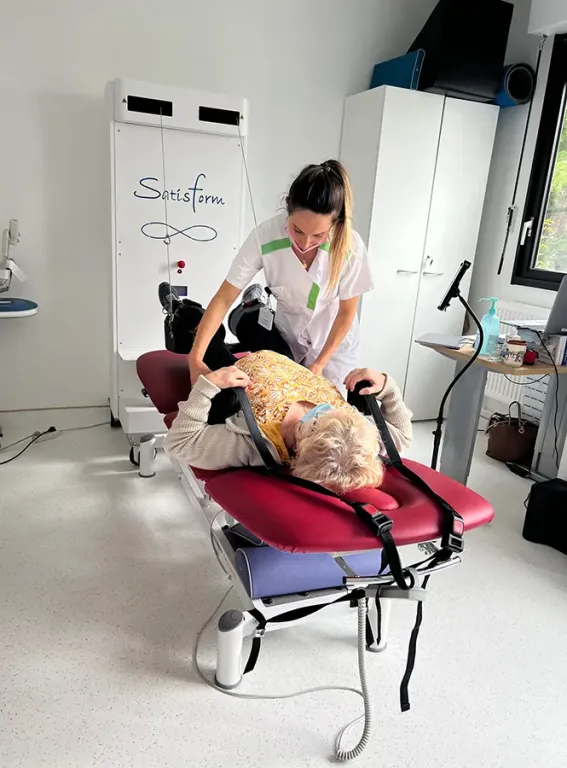
Official Satisform illustration showing an adult using DPA Med. This image does not depict a participant in the pediatric study.
What does “no documented adverse event” mean in a research publication? For a professional assessing rehabilitation equipment, the answer depends on the study design, the information collected and the population observed. The 2025 pediatric study of DPA Med provides information about tolerability, with limitations that should remain visible whenever its findings are discussed.
This single-center retrospective study covered 280 pediatric patients and 1,598 sessions. The authors found no device-related adverse events in the records. The finding remains limited by the available documentation and does not establish zero risk or clinical efficacy. [1]
A retrospective study examines information already collected during care. It answers a different question from a trial that specifies its measurements, assessment schedule and comparison in advance. Interpreting a result therefore requires looking at what the method could detect, rather than relying on the session count alone.
Tolerability concerns adverse effects associated with use. Efficacy concerns achieving a clinical objective, such as a change in pain, function or an activity that matters to the patient. A finding about the first cannot establish the second.
An efficacy evaluation might ask whether a specified program produces a measurable benefit compared with a defined care approach, and whether that benefit lasts. The outcomes, follow-up and other treatments must allow the observed difference to be interpreted. Tolerability data cannot take the place of that comparison.
Satisform describes DPA Med as a mobilization device with decompression and active participation possibilities that depend on the configuration and program. These options should be considered within the applicable instructions for use and professional assessment, without assuming a particular outcome for every patient. [4]
An earlier kinematic study in 30 healthy adults examined pelvic movement, including a frequency of 0.808 Hz within its protocol, without demonstrating clinical improvement or superiority over a traction table. [2]
The pediatric publication discloses Satisform connections: Christophe Bensoussan is its CEO, and Lise Maillard received a company scholarship for her master’s internship. [1]
Such transparency belongs in a scientific reading of the paper. It calls for attention to methods and conclusions, alongside sample size, measured outcomes and reproducibility. It does not replace scrutiny of the study design.
A demonstration can help a team observe the movement, understand settings and discuss setup, precautions and training. Before arranging one, identify the questions your team wants to answer: which functions should it examine, which documents should it review and how would it assess integration into its working environment?
Watching a session alone cannot predict an individual benefit. A video or an ultrasound observation is not a comparative clinical trial either. A demonstration should inform a professional assessment with clear objectives and limits.
Contact Satisform to discuss your practice setting or request a DPA Med demonstration. Describe your team’s needs without sharing information that could identify a patient.
Contact Satisform or request a demonstration
No. Any claim needs to specify what was assessed, under which conditions and over what period. A tolerability finding should not become an individual guarantee.
No. A walking-related claim requires suitable functional measures and a study designed to address that question.
No. It is an option to consider according to the configuration, the person’s capabilities and the program defined by the professional. An available function is not a universal prescription.
Ask for the applicable instructions for use, setup information, precautions, contraindications and training requirements, together with publications relevant to your team’s questions.
Article references: [1] Letellier et al., 2025, pediatric study; [2] Bensoussan et al., 2021, kinematic study; [4] Satisform product presentation. Full links appear at the end of this document.